A Macro Trading Thesis That Can Be Wrong
Turn a broad market story into a dated hypothesis, an observation plan and a record of what would invalidate the interpretation.
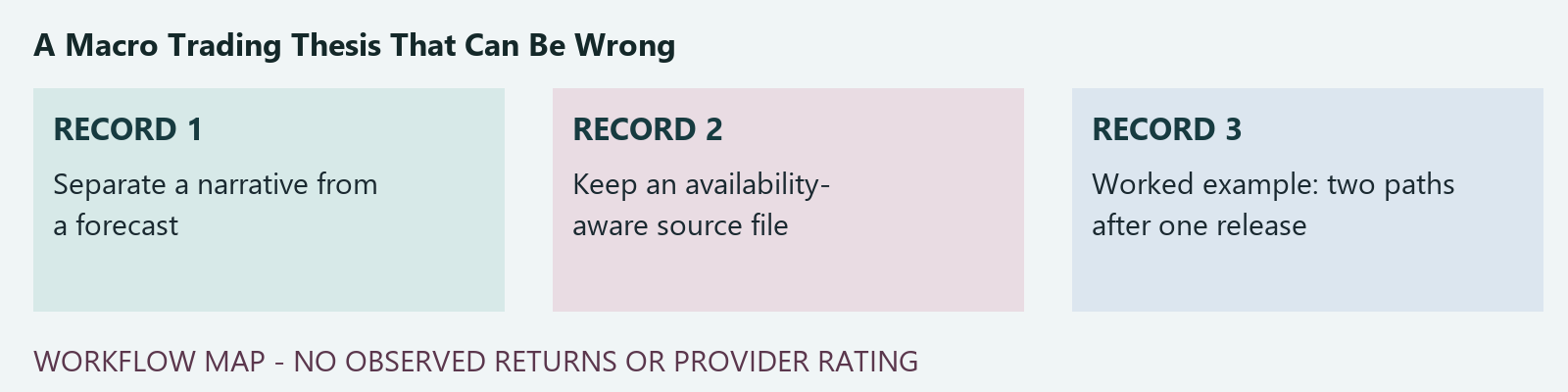
Separate a narrative from a forecast
A story about rates, growth or liquidity can connect many facts without specifying a testable prediction. State the market object, observation window and proposed response separately. A forecast of lower policy rates is not automatically a forecast of higher prices for every risk asset. Expectations, positioning and the information already embedded in price remain part of the question. A useful editorial note identifies those competing explanations rather than presenting one macro narrative as the unavoidable meaning of the next market move.
Keep an availability-aware source file
Write down when each observation became available, not just the date it describes. A revised economic release and its initial publication are different inputs for reconstructing an earlier decision. Preserve the initial value, the revision, the source and the time at which you accessed them. The purpose is to distinguish an honestly dated interpretation from a polished hindsight story. This chapter does not supply a historical macro dataset or claim an empirical trading result; it describes the record a future analysis would need.
Worked example: two paths after one release
Invent a thesis that slowing growth will lower yields during the next observation window. Path one is weaker activity with easing inflation; path two is weaker activity with a renewed inflation shock. The same growth signal appears in both paths, but the second can conflict with the proposed policy response. Before observing prices, write which additional releases would discriminate between the paths and when they arrive. Do not invent numerical likelihoods. The exercise is complete when its competing predictions and invalidation conditions are explicit, even if no trade is proposed.
Translate the view into an instrument question
Choose the instrument identity and explain why its exposure matches the thesis. A cash bond, futures contract, equity and derivative on an equity are not substitutes simply because they can react to rates. List currency, maturity, contract multiplier, expiry and funding where applicable. CME documentation can anchor contract and margin terminology; current product specifications and broker terms still control an actual position. A low margin requirement is not an estimate of maximum loss or a statement that the macro view is inexpensive to express.
Write the adverse interpretation first
Describe what observation would weaken the thesis, what would merely be noise under the declared window, and what would require abandoning the analysis. Do not move the deadline after an unfavourable outcome without preserving the original version. Keep analytical invalidation distinct from account risk management; a narrative can remain plausible while a position becomes unsuitable or an intended exit is not executable. SEC order guidance helps explain why the execution instruction needs its own record instead of being inferred from an analyst's confidence.
Close the editorial loop without hindsight
At the review date, compare the original hypotheses with the information actually available during the window. Separate observation, interpretation and hypothetical execution. Include the opposing path even when the preferred narrative looks persuasive afterward. The outcome may be inconclusive, wrong or correct for reasons outside the thesis. Preserve that distinction. A useful macro archive shows how questions evolved, not just a succession of confident stories. Readers should be able to reconstruct what the writer knew, what was predicted and why the later interpretation changed.
Decision record
| Question | Record to retain | Decision boundary |
|---|---|---|
| Hypothesis | Instrument, window and expected observable change | A theme alone does not define a forecast |
| Information clock | Initial release, revisions and access timestamps | Later revisions cannot be earlier knowledge |
| Competing path | A prewritten alternative explanation and discriminator | Do not erase the alternative after the outcome |
| Review | Original version, new observations and explicit conclusion | Analytical correctness is not proof of executable profit |
Blank working record
The worksheet contains column headings only. Enter your own dated observations, keep absent evidence marked unknown, and do not treat the file as certification.
 Download worksheet (CSV)
Primary references
- CME: tick movements and contract specifications
- CME: performance bonds and margin
- SEC: order types and execution limitations
These documents support mechanisms and source definitions, not a tested trading result or a recommendation. Accessed 9 October 2026. The decision workflow and invented examples above are editorial exercises.
Keep reading
Publication methodology | Working glossary | Source and correction policy